

Three sets of numbers about toys were published this autumn, in three countries, by three organisations that do not coordinate with each other. Read separately they look like three local stories. Read together they describe one problem, and it is not the problem most buyers are looking for.
In the west of Scotland, Trading Standards inspected 32,316 toys across 165 retail and wholesale premises. 18,075 of them — more than half — were found to be non-compliant or unsafe, as BBC News reported on 8 October 2026. In the United States, the Consumer Product Safety Commission reported that it had identified 55 shipments of violative squishy toys at ports and worked with Customs and Border Protection to stop 355,683 units from entering the country. And on 17 November, U.S. PIRG Education Fund published its annual toy safety survey, counting 110 toy recalls and 20 commission warnings between November 2025 and October 2026, involving more than five million toys.
None of those failures could be identified by picking the toy up.
What the 2026 Numbers Actually Say
| Figure | What it counts | Source | Date |
|---|---|---|---|
| 18,075 of 32,316 | Toys inspected in the west of Scotland found non-compliant or unsafe | BBC News | 8 Oct 2026 |
| 55 shipments / 355,683 units | Violative squishy toys identified at US ports and stopped with CBP | CPSC, release 26-684 | 5 Aug 2026 |
| 110 recalls, 20 warnings | Toy enforcement actions in the US, Nov 2025 to Oct 2026 | U.S. PIRG Education Fund | 17 Nov 2026 |
| 900+ notices of violation | Notices issued against toy shipments at US borders, Jan–Jul 2026 | U.S. PIRG Education Fund | 17 Nov 2026 |
| 180,900 | Toy-related injuries treated in US emergency rooms, children 14 and under (2024 figures) | CPSC data cited by U.S. PIRG | Reported 17 Nov 2026 |
| 78.3% | Share of toys imported into the US in 2024 that came from China | BBC News, citing US figures | 14 Oct 2026 |
Two things stand out. The first is scale: 900-plus violation notices in seven months is not a handful of bad actors slipping through, it is a pattern at the border. The second is that the patterns recur across two regulatory systems that share no paperwork — the UK inspection programme and the US port programme were looking for different things and kept finding the same thing.
The Failures Share One Thing
Read the two regulators side by side and the same list appears.
The UK labelling duty has two halves, and buyers routinely collapse them into one. The manufacturer must put its name, registered trade name or trade mark, a contact address and information identifying the toy — type, batch, model or serial number — on the toy itself, or on the packaging or an accompanying document where the toy is too small. The importer must then add its own name and postal address alongside the manufacturer’s, and the importer is by definition a business established in the UK: a supplier outside the UK cannot carry that role for the GB market. The manufacturer’s address does not have to be British. The importer’s does. A CE mark is still accepted in Great Britain alongside UKCA, and importer details may sit on packaging or accompanying documentation rather than on the toy itself until 31 December 2027.
CPSC’s August alert on counterfeit squishy toys lists the failure modes in almost the same order: products that lack required warnings, age grading, tracking information or manufacturer identification, and that are sold without the testing and certification required for children’s products.
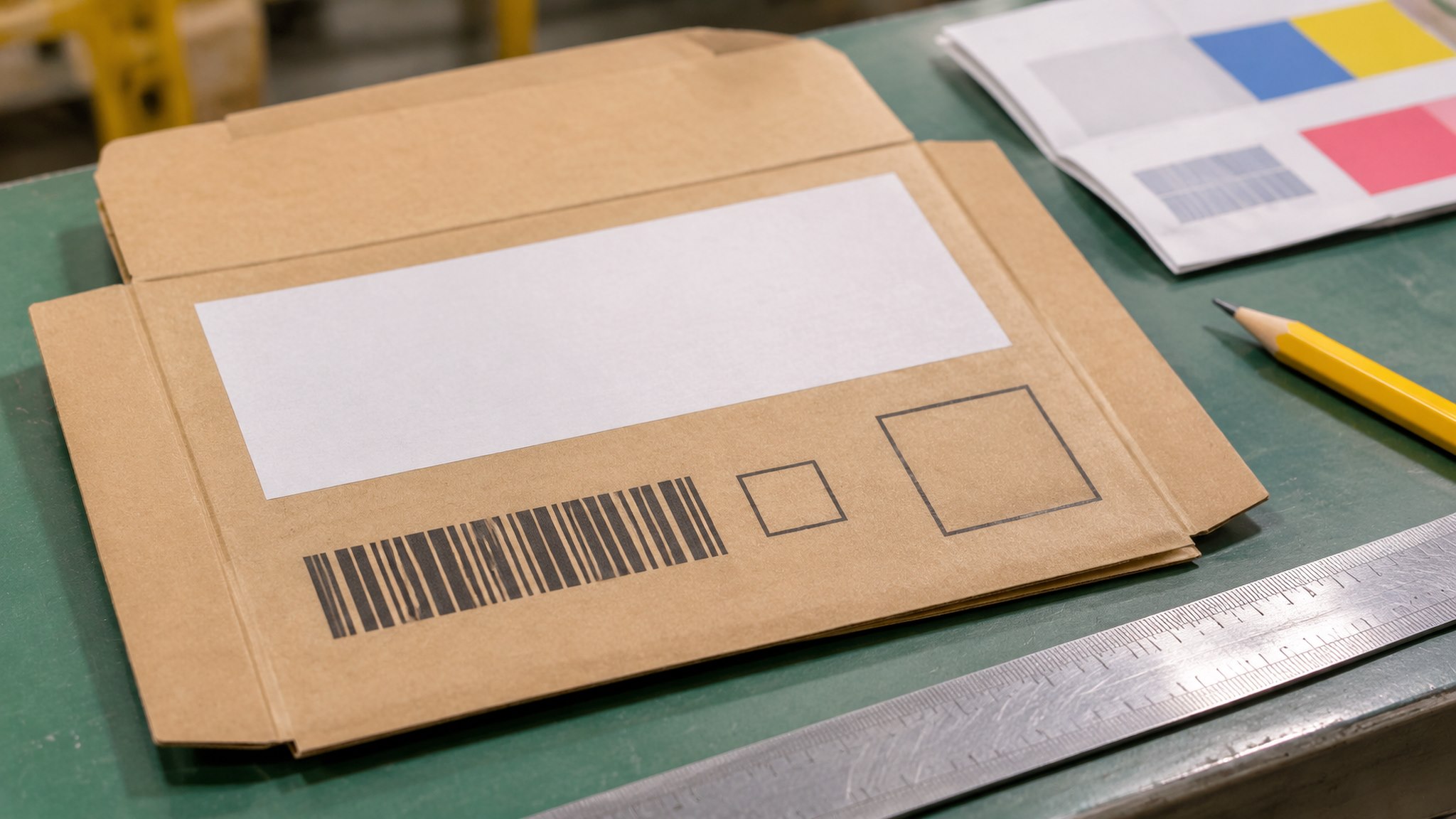
Every field on this panel — importer name and address, age grading, batch or tracking mark, conformity mark — is a printing decision taken months before the container is loaded.
Small parts and chemical limits are physical failures. But the reason a shipment of them arrives at all is a documentation failure, and the two are connected: a factory that has genuinely tested a toy knows what a tracking mark is for. A factory that has printed a logo and a CE mark on a box has no reason to keep the two in step.
Where the Six Dollars Goes
The BBC traced a toy from a factory floor in Dongguan to a US shelf in October, and the cost stack it published explains why compliance failures are structural rather than accidental.
On a $30 toy, the factory receives about 20% — six dollars. That six dollars has to cover the plastic, the moulding, the assembly, the wages and whatever profit remains. Chinese factories typically make between 3% and 10% net, according to Basic Fun chief executive Jay Foreman, who was interviewed for the piece. On a six-dollar factory price that puts the factory’s actual profit somewhere between 18 and 60 cents.
Freight adds roughly 10% of manufacturing cost, about 60 cents. Duty is the line that moves, and it is the line most quotations get wrong.
The 12.5% that circulated in the autumn is real, but it is one measure rather than a rate. It is the Section 301 forced-labour duty that the US Trade Representative imposed on 23 July 2026 and that took effect on 24 July 2026, after investigations into 60 economies that do not impose or enforce a ban on imports made with forced labour. China sits in the 12.5% tier; the ten per cent tier covers the economies that already had a ban or committed to one. This is a separate action from the older Section 301 lists, and it applies on top of whatever else your entry attracts.
So the duty on a toy is not a single number. It is the base rate for your HTS line, plus any legacy Section 301 duty that line still carries, plus this 12.5%, less whatever is exempted in the annexes to the July action. Toys are usually entered under HTSUS 9503.00.00, but a toy with Wi-Fi, Bluetooth or Ethernet is classified elsewhere and can attract a different stack. We are not going to print a blended percentage here, because it would be wrong for some of your shipments and right for others, and a wrong landed cost is worse than no landed cost.
One correction worth making explicit: duty is assessed on the customs value, which is generally the transaction value — the price actually paid or payable for the goods, adjusted — not on the factory’s internal cost and not on the shelf price. International freight and insurance to the United States are excluded from that value; assists, packing and certain commissions are not. A quotation built as “manufacturing cost plus 12.5%” and one built on customs value will not agree, and the gap is yours.
What a buyer can do with this is narrow and useful. Ask your customs broker for the duty stack on your specific HTS line and your specific entry date before you approve a landed cost, and ask again if the classification changes because a radio module went into the mould. On a six-dollar factory price, the 12.5% layer alone is about 75 cents a unit. Anything above that depends on your line, not on ours.
The rest of the shelf price stays in the destination country, split between duty, the importer, the domestic carrier and the retailer. At the 12.5% layer alone that is roughly three-quarters of a $30 toy, which is the figure the BBC reported.
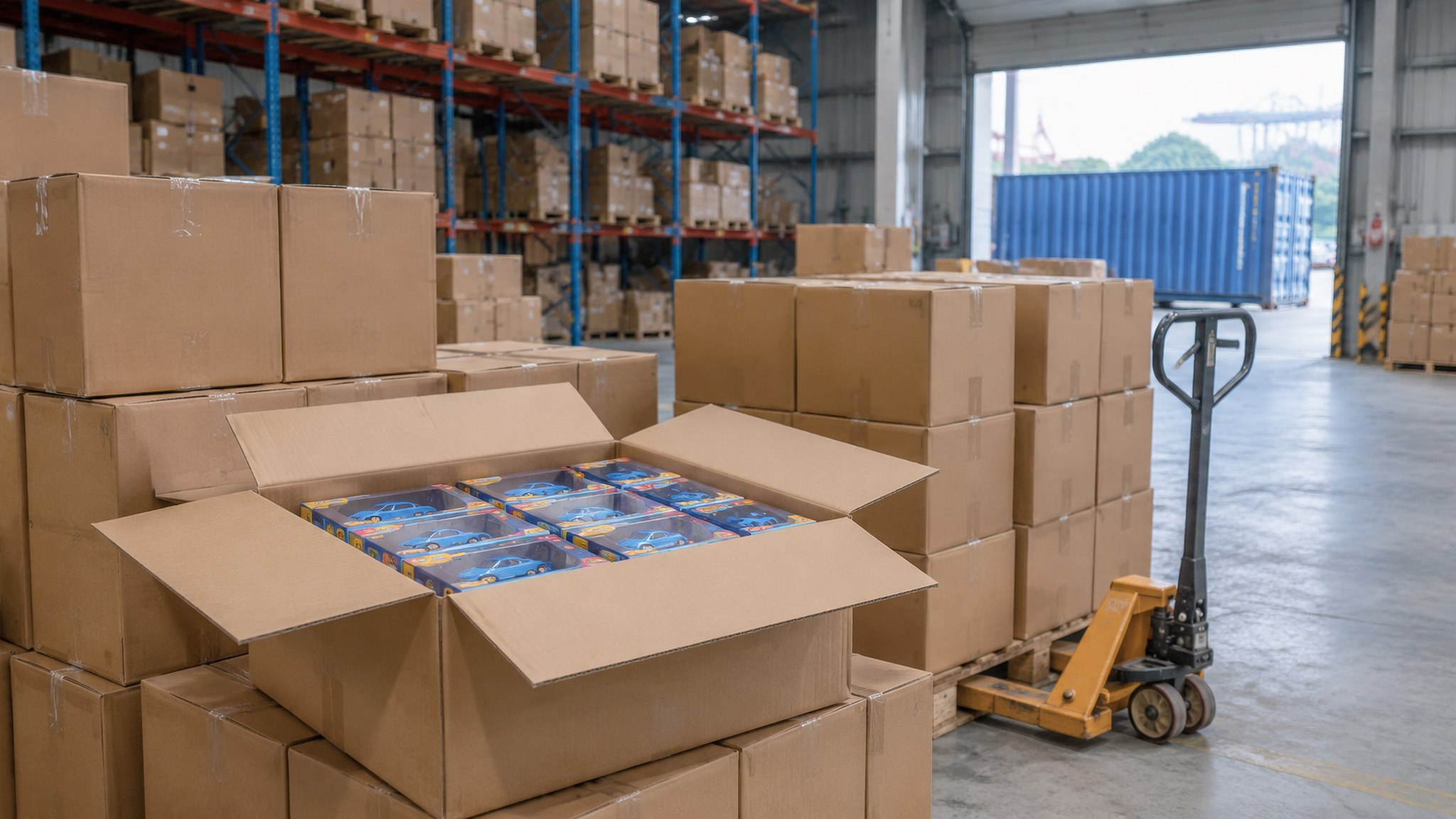
The margin that funds testing, labelling and traceability has to exist before the order is confirmed. It cannot be added once the goods are in a warehouse like this one.
Put those numbers next to a quotation and they become a screening tool. At 18 to 60 cents of margin per unit, there is no slack anywhere in the chain to retrofit compliance after the fact. Testing, labelling and traceability have to be priced into the quotation, or they do not happen. A supplier quoting well below the market while promising a full test programme for every model is describing a business that does not exist — and the 900 notices of violation are what happens when buyers accept that description.
Three Documents That Settle the Question: Test Report, Declaration of Conformity and CPC
You cannot inspect a factory from a product photograph. You can, however, ask for three things and watch how quickly they arrive.

Three different documents get called “the certificate”, and they are not interchangeable. A laboratory test report is issued by the laboratory; it names the samples, the test clauses and the standards, and it reports results. An EU declaration of conformity is issued by the manufacturer; it states which legislation and which standards the toy is declared against, and the manufacturer signs it and carries the legal responsibility for what it says. A Children’s Product Certificate is the American document with a similar job: for goods made outside the United States the importer is the party the law makes responsible for issuing it, it must rest on testing at a laboratory accepted by the CPSC, it must be in English, and it must be filed electronically with the entry or travel with the shipment.
1. The test report. It is the only one of the three that contains measurements. Ask for it by number, and read the model list rather than the cover page. Then ask for the declaration of conformity separately — a supplier who can produce one and not the other has told you something about their file.
2. The label artwork proof. Not the finished carton — the proof, before printing. It should carry the manufacturer name and address, the importer name and address for the destination market, the age grading, the batch or tracking mark, and the conformity mark. The single most common failure in the Scottish inspection was missing name and address information. That is decided at the artwork stage, months before the container ships.
3. The link between the two. The model number printed on the report has to be the model number printed on the carton. If the report names a series and your order is a variant, ask which variants the report actually covers. A series report is not a blanket.
If all three arrive within a day, you are dealing with a supplier who has them to hand. If the third one takes a week of emails, you have learned something more useful than any factory video.
What a Test Report Does and Does Not Cover
Five limits worth knowing before you rely on one.
| Document | What it actually proves | What buyers wrongly assume it proves |
|---|---|---|
| Test report (laboratory-issued) | Named samples met named standards during a named period | That every model in the catalogue is covered |
| EU declaration of conformity (issued by the manufacturer) | That the manufacturer declares the toy meets the named legislation, and carries legal responsibility for that declaration | That a laboratory or a notified body verified it |
| Children’s Product Certificate (issued by the US importer) | That the certifier attests compliance with named rules, on the basis of testing at a CPSC-accepted laboratory | That the CPSC approved the product |
| Accreditation logo (CNAS, ILAC-MRA) | The laboratory’s competence was assessed | That the destination market accepts that laboratory |
| Conformity mark on the packaging | The supplier applied a mark | That a technical file exists behind it |
The test report describes samples, not a product line. A report covers the specific samples tested during a specific period. A new colourway, a changed mould or a different component supplier is a question, not an assumption.
It names the standards it names, and no others. A report for mechanical and physical properties says nothing about chemical migration. Buyers routinely assume a thick report covers everything; the cover page usually lists four or five test items, not forty.
Laboratory accreditation is not the same as regulator acceptance. CNAS and ILAC-MRA accreditation is verifiable and meaningful, but the United States requires testing at a laboratory accepted by CPSC under its own scheme. A report from a well-accredited lab can still be the wrong report for a US entry.
Standards families do not substitute for each other. EN 71 is not ASTM F963. A toy tested to the European standard has not thereby been tested to the American one, and treating the two as interchangeable is how a compliant factory ends up with a non-compliant shipment.
One timing note for the EU. Regulation (EU) 2025/2509, adopted on 26 November 2025 and published in the Official Journal on 12 December 2025, repeals the Toy Safety Directive. It is not the rule you are shipping against yet: toys placed on the market today are still assessed against the Directive, so the declaration of conformity you are collecting now is the right document to collect. Ask your notified body for the transition date before you design packaging around the new regime.
Which Documents, by Destination
The same toy needs different paperwork depending on where it lands, and a supplier who answers the question the same way for every market has not understood it. This is the short version.
| Destination | What the file has to contain | Who issues the document that matters | What to ask for |
|---|---|---|---|
| European Union | EN 71-1, EN 71-2 and EN 71-3, plus the REACH restrictions that apply to the materials; EN 62115 and EMC where the toy has sound, light or a motor; CE marking and a technical file | The manufacturer issues the EU declaration of conformity and holds the technical file behind it | The declaration by model, and the report numbers behind it |
| Great Britain | BS EN 71 equivalents, UKCA or CE marking, and the manufacturer’s identification on the toy or its packaging | The manufacturer declares conformity; the UK importer then adds its own name and postal address, and must be established in the UK | The name of the UK importer. If nobody is named, the role is unfilled |
| United States | ASTM F963, CPSIA including lead and phthalates, small-parts rules, and a tracking label fixed to the product and its packaging | The importer issues the Children’s Product Certificate, on the basis of testing at a laboratory the CPSC accepts | The report number and the laboratory, then check that laboratory against CPSC’s own list |
| Anywhere else | National schemes, which differ: Saudi Arabia runs SASO through the SABER platform, Brazil runs INMETRO | The importer or local agent, usually | The destination, before the order. Neither scheme accepts a European or American file in its place |
None of these files substitutes for another. A European report does not open a US entry, and a US certificate does not discharge a UK importer’s duty. That is the whole reason the file is worth asking about rather than assuming.
Where This Year’s Hazards Sit
The five categories PIRG identified this year are specific: squishy fidget toys containing water beads, pull-string activity and teething toys for infants, AI-enabled toys with weak conversational guardrails, toys bought online from unfamiliar sellers, and recalled or counterfeit goods still on sale.
PIRG makes a point that is easy to miss: apart from recalled and counterfeit products, none of these categories represented a significant threat ten years ago. They are not old hazards getting worse. They are new product types outrunning the rules written for the old ones.
The squishy category alone explains why regulators moved on it. BBC News reported on 29 June 2026 that a Glasgow children’s hospital had treated six children in eight months for burns caused by heating squishy toys in microwaves, some requiring surgery and skin grafts. CPSC’s August alert covers the same product type from the import side: without age grading, warnings and manufacturer identification, a product that generates a viral play trend reaches children with no instructions at all.
That matters for buyers sourcing injection-moulded plastic toys, because the risk profile is different in kind. A rigid PP or PS playset has no gel filling, no rechargeable cell and no microphone. Its failure modes are the unglamorous ones: a small part that detaches under the drop test, an edge that sharpens, a coating that carries something it should not, a panel printed without an importer address. Those are the failures the Scottish inspection found, and they are the failures a factory can control — if it is testing the actual model rather than the family.
It also means the line between categories is not where buyers assume. Our four-level parking garage is a battery-free mechanical moulding with no ingestible content. Our cash register playsets contain sound and light electronics, which brings in a separate set of electrical standards — EN 62115 and EMC in Europe, additional requirements in the United States — that a mechanical moulding never touches. Those are a different file from the EN 71 report, held by a different route, and we deal with them model by model. Same factory, same plastic, materially different compliance file.
What We Claim, and What We Do Not
Given the subject, it would be strange to write this and then be vague about our own position.
We hold EN 71-1, EN 71-2 and EN 71-3 testing, including the EN 71-3 A2:2024 revision, plus the BS EN 71 equivalents, for the parking-lot range. The report is RGST250403809, issued in April 2025, and it names the models it covers — 7158 among them, with the rest of its range listed on the report rather than summarised here. We are giving you the number so you can ask for the PDF and read the model list yourself. A report number that cannot be checked is decoration.
For the cash register range the position is narrower, so we will state it narrowly. The 818 series and the 2020 series are covered by EN 71-1, EN 71-2 and EN 71-3 reports and BS EN 71 equivalents issued in 2025, with cadmium and PAH reports from 2023 and RoHS reports from both 2023 and 2025. Those reports were written against the models they list. They do not cover every cash register we have made, and a new item in the range starts at zero until it is tested — which is the point the rest of this article is making, so it would be strange to exempt ourselves from it.
You will not find an ASTM F963 badge on this page, and that is deliberate — the same principle the rest of this article applies to everyone else. The document behind that badge is model-specific and laboratory-specific, and the Children’s Product Certificate is issued by the importer on the basis of testing at a laboratory the CPSC accepts, not by us. So ask for the report number for the model you are buying, and the name of the laboratory that issued it, and check that laboratory against CPSC’s own list. That is a shorter conversation than the one you will have with a customs broker after the container lands, and it is the only version of this claim worth printing.
If a document does not exist for an item, we will say so rather than describe the item as tested. On a site where the alternative is a printed CE mark and no file behind it, that is the whole offer.
A Checklist for Your Next Purchase Order
- Ask for the report, not the certificate. Then read the model list, not the cover page.
- Match the model number on the report to the model number on the carton. If they differ, ask why before you pay a deposit.
- Approve the label artwork, not the carton. Importer name and address, age grading, tracking mark, conformity mark.
- Ask which standards the report does not cover. A supplier who can answer this quickly has read their own file.
- Ask what triggers a retest. Colour, mould, component source. If the answer is “nothing”, the file is out of date.
- Check the laboratory against your destination market’s acceptance scheme, not just its accreditation.
Send us the market you are selling into and the standard your retailer requires, and we will reply with the reports we hold for the specific model you are asking about — including, where relevant, the ones we do not have. Start that conversation here, or browse the full product range.
Post time: Nov-23-2026