

In October 2026 a parent posted a question on Mumsnet’s toys board: recalls had been in the news all year, and she was no longer sure where to buy toys she could trust. Seven people answered.
None of them named a standard. Nobody mentioned a test report, a declaration of conformity or a conformity mark. They named shops — The Entertainer, Early Learning Centre, Smyths, Jaques, Argos, John Lewis, Babipur — and one listed brands instead: Duplo, Brio, Bigjigs, Little Dutch, Le Toy Van, Tenderleaf. That is the pattern across the threads reviewed for this article: in these discussions, safety is not treated as a property of the product. It is treated as a property of the seller. It is a statement about a handful of threads, not about parents in general.
Why the Shop Name Wins
A parent in a shop cannot audit a factory. What she can do is buy from a name with something to lose. One reply made it concrete: a relative gave her son a toy car, the battery compartment broke off within an hour, and the button cells fell out. Her verdict was not that the toy failed a standard. It was that cheaply made things are not worth the risk. Your compliance file is invisible to the person who decides; it becomes visible only when an importer or marketplace is asked to carry the liability — which is why an unbranded listing with a clean test report still loses to a shop name.
The Instrument a Parent Does Not Have
On BabyCenter’s boards the question shifts. In the threads read here, the Mumsnet posters asked which shop; the American posters asked whether standards are enforced at all. Both are forum threads, not a survey of either country.
“Car seats are held to a specific standard when sold in the US and you can see which manufacturers are doing what. You can also see if there are any recalls you can keep an eye on from that specific company.”
That parent had an instrument: a named standard, a way to see who complies, a recall register searchable by company. Given one, she reached a precise conclusion. Offer the same shopper a twelve-dollar toy and there is no named standard on the listing, no register indexed by factory, and no way to tell a licensed product from a copy carrying the same photographs. Buying on price is the reasonable response to that.
Two Numbers That Look Like a Contradiction
The Toy Association’s November survey of 1,000 US parents found 87% saying a counterfeit’s lower price was not worth the safety risk, and 84% saying they believed knockoff squishy toys were safe. That reads as incoherence and is not: asked in the abstract, parents reject fakes; asked about the toy in front of them, most assume it is fine, because a counterfeit does not announce itself.
The association’s study of 24 November 2026 measured the gap. Toys bought from Temu and Shein and tested at a CPSC-accredited third-party laboratory: 89% failed on one or more factors — a mandatory safety test, or labelling and age grading, or both; 67% failed at least one mandatory safety test; 40% failed small-parts testing; one carried phthalates more than 90 times the federal limit. The release describes the sample as dozens of toys and gives no breakdown by platform, so read those figures as a finding about the toys purchased, not about every toy sold on either site.
Parents Are Shopping for Millimetres
On 23 September a parent asked for a marble run for a three-and-a-half-year-old who still mouths things. She wanted balls that could not be swallowed. The useful replies answered in dimensions: larger balls, bigger parts, and a warning that a competitor’s junior set would still be a choking hazard.
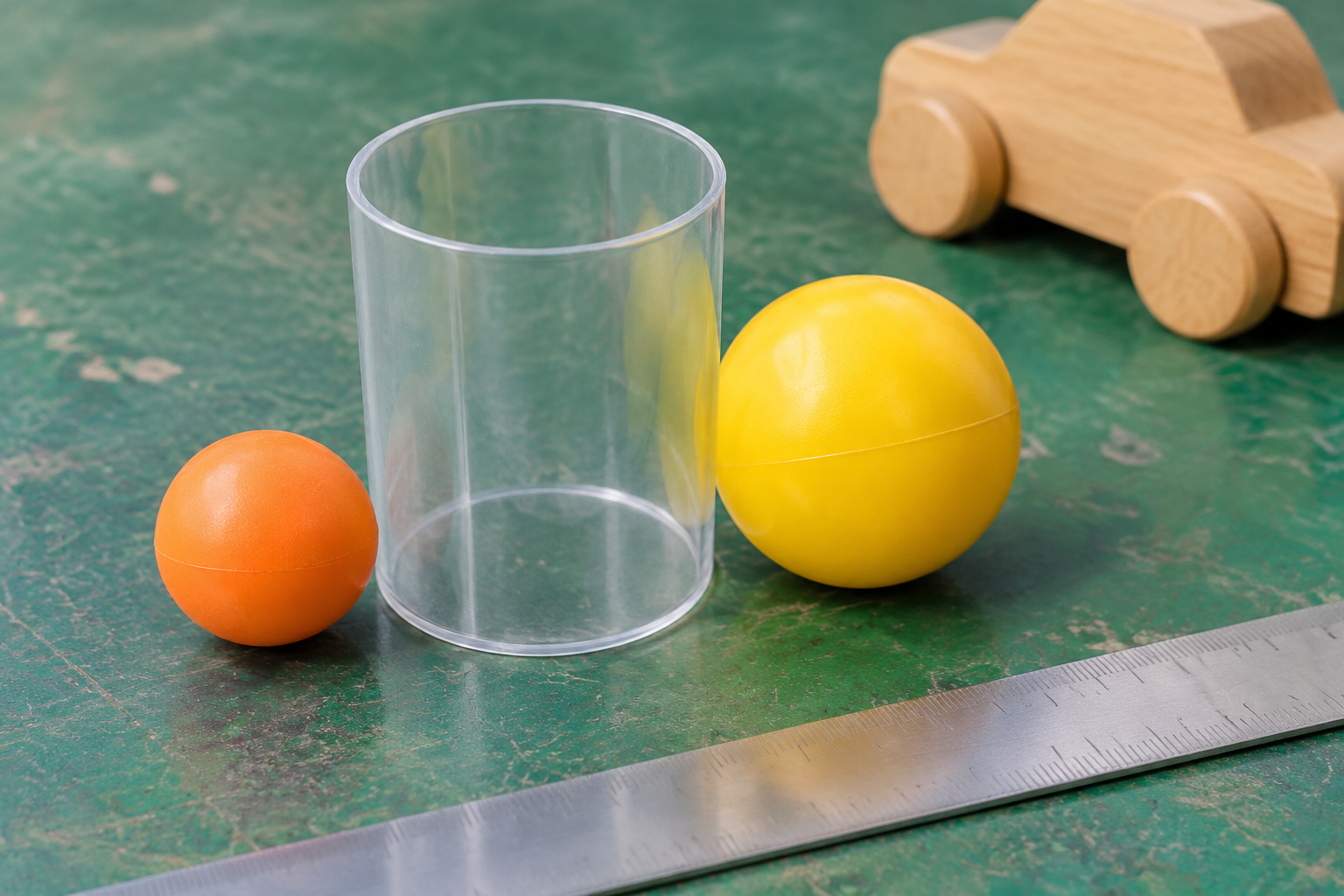
That is a parent asking for a millimetre figure in the only vocabulary she has, and it is a useful signal from a factory’s side of the counter — but it is not a rule for setting an age grade. Part dimensions are one input among several. An age grade also has to reflect the play pattern and the age that play pattern is written for, the product’s design and construction, and the results of the small-parts and use-and-abuse testing that applies in the destination market. A ball the size of a ping pong ball tells you that component is unlikely to present a small-parts hazard; it does not, on its own, make a toy suitable for a three-year-old.
Parents also read how parts are attached, not only how big they are. On a BabyCenter thread from August 2023, one described a fidget toy bought for a baby: “It has little wooden eyeballs just glued on top. 100% choking hazard that will fall off.” Glue is a factory decision; to the buyer it is a photograph.
The Rejection Is Not Plastic
In April a mother posted about her mother-in-law arriving every fortnight with another electronic toy: “Flashing lights, tinny music, buttons that shout colours at him in an American accent.” Her 13-month-old cried. The thread drew 42 replies and 57% said she was not being unreasonable. The reply that matters disagreed with the premise while conceding the problem:
“loads of the plastic stuff, especially cheap unbranded stuff is tat, but I actually think a lot of vtech stuff is pretty good”
The objection is not to polymer. It is to overstimulation, weak construction and a product with no name on it. The Toy Association’s 2026 trends briefing reached the same place from another direction: families “choosing tech-free toys that help them power down and reset,” framed as a conscious reset rather than a rejection of technology.
Where Our Own Range Sits
Two of our lines land on opposite sides of that finding, so it is worth saying which is which. Item 7158, our four-level parking garage, is entirely mechanical — no batteries and no motor, as its product page states. The parts to watch with children under three are the small cars and road signs, and the page says so. That description belongs to that one model; it is not a statement about the rest of the range.
Our engineering range is mixed and we will not describe it as one thing. It includes a remote-control fire truck and a friction fire engine listed with lights and sound, so the electronic models differ from each other as well. Ask for the specification of the model you are quoting.
Our cash register playsets sit on the electronic side too. The interactive register’s listing documents an LCD screen, a simulated scanner, a card slot, manual receipt scrolling and a pop-out cash drawer, and sound and light vary by model. We are not going to describe them as quiet toys; check the specification of the model you are quoting.
What to Fix Before the Next Purchase Order
Decide whether you are selling as a brand or as an unbranded listing, because the document set and the packaging differ. Record the dimensions of your largest detachable parts, then set the age grade from the small-parts and use-and-abuse results, the play pattern and the intended age — not from one measurement. Screw-fix the battery door; it is the first failure a parent will photograph. And design the age marking for someone who never read the listing — 35% of parents treat age recommendations as suggestions, rising to 49% among Baby Boomers, many of whom do the buying.
Since 12 March 2026, water beads sold in the United States must also meet a new federal standard on expansion size, acrylamide and warning labels. Two forums are not a sample, the US survey figures come from the industry being surveyed, and Reddit blocked automated access on every attempt — nothing from it is quoted here. What the threads show is what is being argued about, not what most parents think.
Post time: Nov-25-2026